

Opinion: June 12, 1993, and June 9, 2015. By Olatunji Dare
The June 12, 1993 presidential election heralded a new dawn in Nigerian politics.
Forsaking tribe and tongue and creed and station, a decisive majority of Nigerians voted to entrust their destinies to the Muslim-Muslim ticket of Bashorun MKO Abiola and Babagana Kingibe, of the Social Democratic Party (SDP). In eight years of virtually unchallenged rule, the duplicitous regime of military president Ibrahim Babangida had led Nigeria to the edge of economic ruin and destroyed the value system. The election offered Nigeria a chance to chart a new course, founded on the principle that governance shall be based on the consent of the people freely given.
Babangida annulled the election, with help from a suborned faction of the SDP, which was only too willing to bargain away its electoral victory and with it, the hopes and aspirations of millions of Nigerians who had given it their mandate. The rest is history.
Of the many political figures complicit in the annulment, two have not only remained in circulation, their stock has risen. I have in mind Brigadier General David Mark who, as a key player in the Babangida regime, is on record as having vowed to shoot Abiola to death if Abiola was allowed to take power David Mark has served as a member of the Senate for 16 years and as its president for the last eight, in which latter capacity he designated himself or was designated His Excellency the Right Honourable David Mark.
I have also in mind Chief Tony Anenih, whose renown as a fixer had been established long before he took the leading part, as national chairman of the SDP, in bargaining away the party's victory in the 1993 presidential election. He has since then made a lucrative career as a fixer for every season.
Wherever a political job of the most unsavoury kind is to be done, like turning winners into losers and losers into winners, there you will find Anenih in his true element. In a way, June 8, 2015, some 22 years removed from the historic 1993 poll, also signalised a new dawn. The two houses of the legislature were to be inaugurated under new management as it were, the APC having wrested them decisively from the PDP. These are the organs through which the APC was going to pursue the agenda of Change on which it had fought and won the election.
To drive the agenda and pursue it faithfully, the APC had to have as the heads of these organs persons whose dedication, loyalty and commitment it can vouch for. In its judgment, Bukola Saraki did not pass that test. He had brought considerable assets to the APC through the ACN when he defected from the PDP, but he was for all kinds of reasons not his party's candidate for Senate president.
As if to prove prescient those elements in the APC who thought him unfit for that high office and to confirm what his fellow Ilorin kinsman Is'haq Moddibo Kawu has written about him, namely, that the only thing Saraki cares about is Saraki, the aspirant surreptitiously cut a deal with the PDP minority, which then voted en bloc with some renegades in the APC to steamroll him to the third rank in the national order of precedence.
To get this dubious support, Saraki bargained away to the PDP the APC's prerogative of selecting the deputy senate president from its own ranks. And in grateful appreciation of his role in facilitating this tawdry enterprise, the conclave elected David Mark "leader" of the Senate, a position that does not exist. A little bankrolling also helped, I gathered.
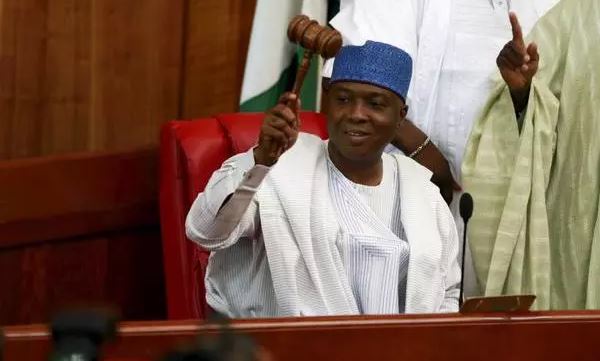
It took 57 of 108 senators, all the 49 from the PDP and eight from the APC, presumably including Saraki, to consummate this subversive deal. There was no dissenting vote. Before many in the attentive audience realised what was going on, Saraki was already ensconced in the Senate president's chair and wielding the gavel.
Such was the rush, the indecent haste with which an event that should have resonated with solemnity and symbolism came across instead as the parliamentary equivalent of a street mugging.
The 51 APC senators who were not on the floor had not willfully absented themselves. They were assembled at another venue, to which all APC senators had been summoned, for an appeal by President Muhammadu Buhari for party unity in the run-up to the election of leaders of the Senate and the House of Representatives.
Saraki may still have won if the election had been conducted with all APC members present and voting. But Saraki being Saraki, he left nothing to chance. Why wait for a vote of the full house and an uncertain outcome when you can achieve your goal through a Faustian bargain? As in the 1993 presidential election, David Mark, and according to media reports Tony Anenih, who was brought out of retirement to do what he does best, played pivotal roles in up-ending established process to achieve partisan, if not personal goals. It is in truth scandalous that David Mark who had served in the Senate since it was set up 16 years ago and presided over it for eight aided and abetted this flagrant abuse of process when he should have stood up robustly for propriety. Where was the "elder statesman" in him? There was a time when the standard justification for a military coup was that politicians or the political class had learned no lessons. Were any lessons taught?
The storied careers of David Mark and Tony Anenih, and indeed Bukola Saraki, whose rap sheet with the EFCC is about a mile long, show clearly that no lessons were taught. That is why Nigeria has been going round and round in an ever -shrinking circle. The usual pettifoggers have been justifying Saraki's coup - for that is what it is at bottom -claiming that it accords with the rules and regulations in force. Even President Buhari has said that it was "somewhat constitutional."
Everything Saraki did may well have accorded with the letter of the law. But did it also accord with the spiritof the law? And is fidelity to the spirit of the law not as important as, if not more important than, fidelity to the letter of the law? Fidelity to the letter of the law, like the sleep of reason, often brings forth monstrosities like the 12 and 2/3 formula that the Supreme Court relied upon to determine the winner of the 1979 presidential election. When the "anything goes" brigade claims that the coup is good for democracy because it will ensure the independence of the legislature, the retort must be: Independence from whom or from what? Independence for what?
To return to the June 12, 1993 presidential election, the 22nd anniversary of which was marked last Friday largely in the Yoruba country: President Buhari's acknowledgement was a desultory tweet that had all the markings of an afterthought. We now know, thanks to Humphrey Nwosu who conducted the poll, that Abiola won it indissolubly. So, the claim that the election was "inconclusive" is no longer tenable. Nor can anyone in good faith now refer to Abiola as the "presumed winner" of that election. In the books of the National Electoral Commission, and in the records of accredited observers, domestic and foreign, Abiola was the actual, outright, undisputed winner, in truth a president-elect, a president–in-waiting. He died defending his mandate, after years of detention in solitary confinement, in the most barbarous of conditions. He rejected shabby and ignoble compromise, the kind that Saraki embraced to win election as Senate president.
A long line of Nigerian rulers, from Babangida to Abdulsalami Abubakar, through Ernest Shonekan and Sani Abacha, suborned the institutions and instrumentalities of the state to persecute, and ultimately murder Abiola and his wife Kudirat, not sparing his global business empire, all because he won an election and would not surrender the people's mandate.
There is only one way to expiate this crime.
It begins with Nigerian state marshalling all its institutions to acknowledge and honour that indissoluble fact. Thereafter, it should officially recognise Abiola as a president-elect who died before he could take office, and accord him all the rights and privileges of a president.
Cloud Tag: What's trending
Click on a word/phrase to read more about it.
Oluronke Adeyemi Talaka Parapo Turaki Of Ilorin Sarkin Malamai Kwara State Health Insurance Agency IDPU Idris Garba Vasolar-Kwara Company Ltd Mukhtar Shagaya Pakata Patriots Economic And Financial Crimes Commission Yoruba Tuesday Assayomo Maimunat Oniyangi Cornelius Fawenu Ayobami Seriki Sulyman Tejidini Shuaib Jawondo Sa\'ad Alanamu Abdulrasheed Na\'Allah Jamila Bio Ibrahim Kwara State Pension Board Salmon Babatunde Salmon Abdulrazaq Magaji Geri-Alimi Split Diamond Interchange Presidential Election Okedare Bamidele Adegoke General Hospital, Offa Baaziki Sulaiman Valsolar Oya State LEAH Charity Foundation Women Radio Dauda Adesola KSIRS Falokun-Oja Agboola Babatunde Gbenga Awoyale Kemi Adeosun Olayinka Jelili Yusuf Oke-opin Yusuf Olaolu Ali Emir Of Yashikira SDP Kwara South Asa LGEA School Oke-Ode Sidikat Akaje Olupako Of Share Lukman Adeloyin Eleja Abegunde Goke Hameed Oladipupo Ali Olaiya Zuberu Baba Issa Awoye Idofin AbdulHakeem Ajibola Akanbi Alabe Toyin Olayinka Tejidini Student Learning Support Helpline Mohammed Katsina Ahmed Dele Momodu Sunday Popo-Ola Eleyele Babatunde Ishola Babaita Peter Obi Bello John Olanrewaju UNILORIN Alumni Association Ayodele Kuburat Olaosebikan Riskat Opakunle Amosa Law School Scholarship Smart School Monkey Pox Federal Polytechnic Offa Ella Supreme Tissue Paper