


University of Ilorin Conference: Customs Boss Adeniyi Urges Responsible Leadership in AI Deployment
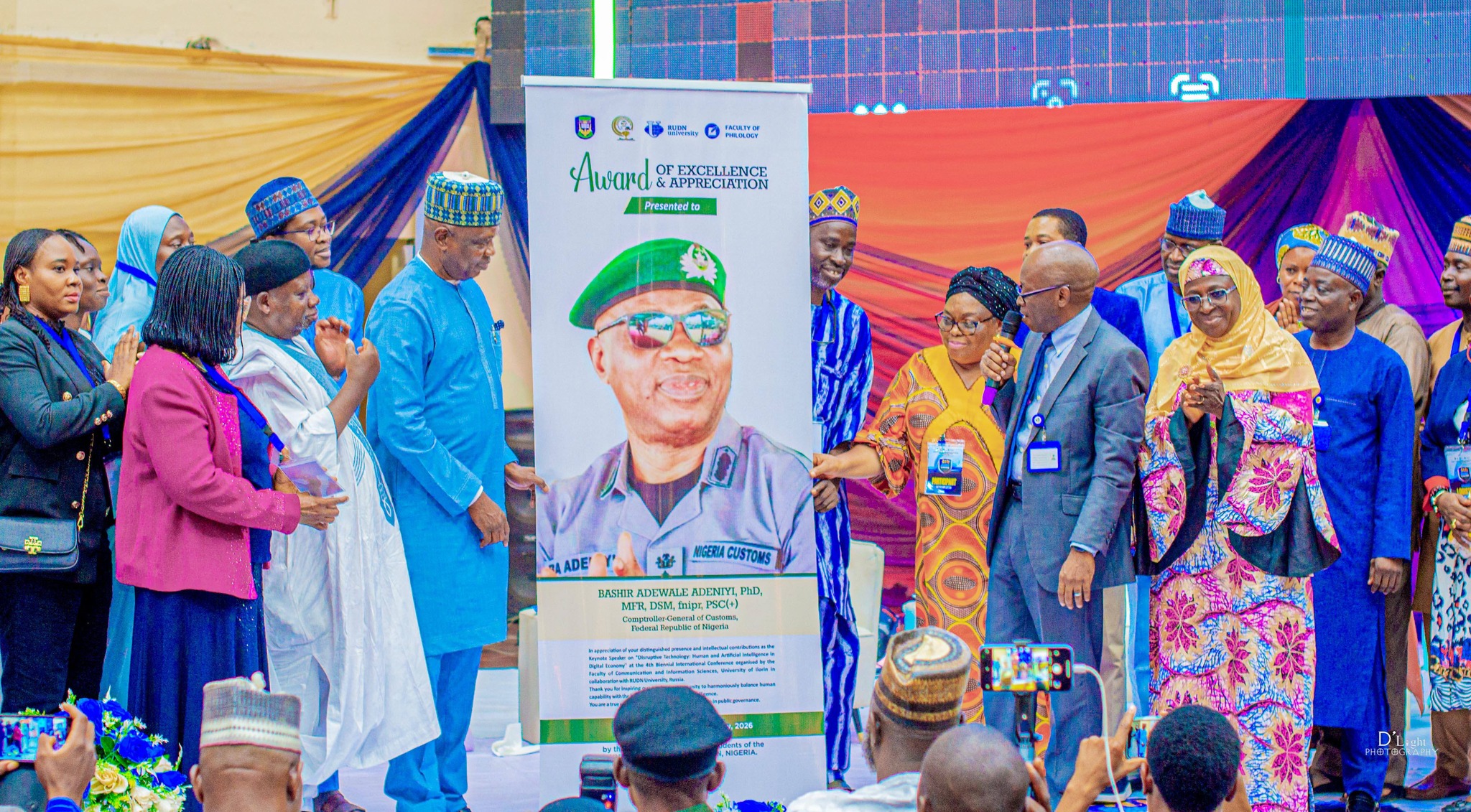
The Comptroller-General of the Nigeria Customs Service and Chairperson of the World Customs Organisation Council, Dr Bashir Adewale Adeniyi, has challenged academics, policymakers and global leaders to ensure that Artificial Intelligence and disruptive technologies are driven by ethics, human values and responsible leadership.
Dr Adeniyi issued the charge last Wednesday (13 May 2026) while delivering the keynote address at the 4th Biennial International Conference jointly organised by the Faculty of Communication and Information Sciences, University of Ilorin, and the Faculty of Philology, RUDN University, Russia, held at the University Auditorium.
The conference, themed "Disruptive Technology: Human and Artificial Intelligence in the Digital Economy", attracted scholars, researchers, communication experts, policymakers, royal fathers, students and development partners from Africa, Europe and Asia.
Addressing the conference theme, Dr Adeniyi described the digital age as fundamentally "a human story", stressing that the real challenge before societies is not the sophistication of machines but how responsibly they are deployed for public good.
The Customs boss maintained that Artificial Intelligence should complement rather than replace human intelligence.
"AI remains a tool; it operates on correlations, not on conscience," he stated, adding that "the partnership, not the rivalry, between human and Artificial Intelligence is where the real value lies."
Dr Adeniyi highlighted the impact of digital transformation within the Customs Service through the B'ODOGWU Unified Customs Management System, which generated over N230 billion at the PTML Command within its first eight months while reducing cargo clearance time for compliant importers to less than eight hours.
He also referenced Nigeria's rapidly expanding digital economy, noting that electronic payment transactions reached N1.07 quadrillion in 2024, while transactions valued at N285 trillion were recorded within the first quarter of 2025.
According to him, while automation may reduce some traditional jobs, emerging opportunities would continue to arise in areas requiring creativity, leadership, emotional intelligence and critical problem-solving skills.
Dr Adeniyi further urged African institutions to develop locally relevant technological solutions rooted in African languages, governance systems, legal frameworks and markets instead of depending entirely on imported models.
Declaring the Conference open on behalf of the Vice-Chancellor of the University, Prof Wahab Olasupo Egbewole, SAN, the Deputy Vice-Chancellor (Research, Technology and Innovation), Prof Muhtar Adieza Etudaye, described the Conference as another remarkable testimony to the enduring academic partnership and intellectual cooperation between the University of Ilorin and RUDN University, Russia.
The Vice-Chancellor stated that the collaboration reflects a shared commitment to advancing scholarship, promoting global conversations and generating practical solutions to contemporary challenges confronting humanity in the rapidly evolving technological age.
He observed that emerging technologies such as Artificial Intelligence, machine learning, automation and digital media are reshaping education, governance, healthcare, business and communication across the world while simultaneously raising important concerns relating to ethics, regulation, employment, privacy and digital inclusion.
According to the Vice-Chancellor, the conference provides scholars and professionals with a strategic platform to critically interrogate the intersection between human intelligence and artificial intelligence within the broader context of the digital economy. He expressed optimism that deliberations at the Conference would generate policy-relevant recommendations capable of advancing responsible innovation and sustainable development globally.
In her welcome address, the Dean of the Faculty of Communication and Information Sciences, Prof Saudat Salah Abdulbaqi, described the Conference as a convergence of ideas, cultures and intellectual perspectives focused on innovation, ethical advancement and global scholarly engagement.
She explained that the Faculty comprises five Departments: Computer Science, Library and Information Science, Information Technology, Mass Communication and Telecommunication Science, which collectively position it as a major interdisciplinary hub for computing, communication systems, information management, digital innovation and emerging technologies.
Prof Abdulbaqi noted that the conference reflects the truly global nature of technological discourse and the collective search for solutions in the digital age, especially as disruptive technologies continue to transform economies, governance, security, education and human interaction worldwide.
She further stressed that the conference theme challenged participants not only to examine the impact of disruptive technologies, but also to explore how human intelligence and artificial intelligence can coexist productively to drive ethical advancement, sustainable development and inclusive economic growth.
The Dean appreciated the support of the University Management under the leadership of Prof Wahab Olasupo Egbewole, SAN, and acknowledged partners, including the Central Bank of Nigeria, FEMTECH, the Advertising Regulatory Council of Nigeria, Prof Yusuf Olaolu Ali, the Kuliya Ngeri of Ilorin Emirate, and Faculty Alumni for supporting the Conference.
She also disclosed that the Faculty seeks support towards transforming its learning centres into smart classrooms as well as providing modern studios, laboratories, lecture theatres, professorial suites and a Faculty bus to strengthen teaching, learning and fieldwork experiences.
In his remark, the Vice-Chancellor of RUDN University, Russia, Prof Barabash Victor Vladimirovich, represented by Associate Professor Mustapha Muhammad Jamiu, commended the Faculty for sustaining the international academic relationship between Nigeria and Russia as well as promoting cross-cultural scholarly engagements between both institutions.
Prof Barabash described the partnership between the University of Ilorin and RUDN University as a reflection of growing international cooperation in research, communication studies, information sciences and digital innovation, with both institutions leveraging intellectual exchange to address emerging global technological realities.
Participants at the Conference noted that the collaboration between the Nigerian and Russian institutions has continued to strengthen academic diplomacy, broaden international research networks and create opportunities for joint innovation, cross-border learning and global scholarly engagement.
In a goodwill message, the Director-General of the Advertising Regulatory Council of Nigeria (ARCON), Dr Olalekan Fadolapo, described the Conference theme as apt and highly relevant to the future of communication and advertising practice in the digital era.
Dr Fadolapo stated that Artificial Intelligence is transforming how content is created, distributed and consumed, thereby opening new opportunities for creativity, efficiency, innovation and economic growth within the communication and advertising industries.
He noted that as the regulatory body responsible for ethical advertising practice in Nigeria, ARCON remains committed to fostering innovation while safeguarding public interest through responsible regulation and professional standards.
According to him, the Council is working towards creating a framework where human creativity and Artificial Intelligence can coexist productively to build trust, promote local content development and contribute meaningfully to the growth of Nigeria's digital economy.
The ARCON Director-General further commended the Faculty for creating a platform that encourages dialogue among academia, industry practitioners and policymakers, expressing confidence that the Conference discussions would generate insights capable of strengthening communication practice, ethical standards and digital regulation in Nigeria and beyond.
Speaking on behalf of the Kwara State Governor, the Senior Adviser and Counsellor, Alhaji Saadu Salaudeen, commended the organisers for convening a Conference focused on the future of technology, innovation and digital transformation.
Cloud Tag: What's trending
Click on a word/phrase to read more about it.
Labour Party Law School Scholarship NITDA Ishola Moses Abiodun Suleiman Idris Elerin Of Adanla Irese Tunde Idiagbon Road Abdullahi Atanda Tafidan Kaiama Halimah Perogi Sardauna Of Ilorin Kolade Solagberu Kayode Zubair Baba Issa Gobirawa Iyabo Adisa Ibiyeye Saraki Volunteers Of Ilorin Community And The Emirate Elewu Ramadhan Mujtabah Bature KWASIEC Kawu Baraje Ilorin Durbar Ahmad Olayiwola Kamaldeen Sunday Popo-Ola Azeez Bello Matthew Okedare Adedeji Onimago Sheriff Shagaya Coalition Of Kwara North Groups Otoge University Road Offorjama Yeketi Oko Erin Oniyangi Air Peace Ibrahim Akaje Unilorin Mutawali Of Ilorin Lanre Issa Onilu Muhammadu Buhari All Confederation Of Principals Of Secondary Schools Mahmud Ayinla Giwa Shaykh Luqman Jimoh Rotimi Atere Funmilayo Mohammed Goodluck Jonathan Tunji Ajanaku TVC Female National Debate Amos Sayo Kulende Isin Olayinka Are Maryam A. Garuba Baba-Isale Yusuf Amuda Aluko Abraham Ojo Olota Of Odo-Owa EFCC MATTA Girls Foundation Kayode Yusuf Okasanmi Ajayi Moji Makanjuola Buhari Kwara Pdp Obasanjo Agbarere Kwara Basketball Association Saudat Abdulbaqi Pakata Patriots Saka Aleshinloye Abubakar Baba Vasolar-Kwara Company Ltd NURTW Balogun Gambari