


FG appeals, says Saraki's acquittal unreasonable
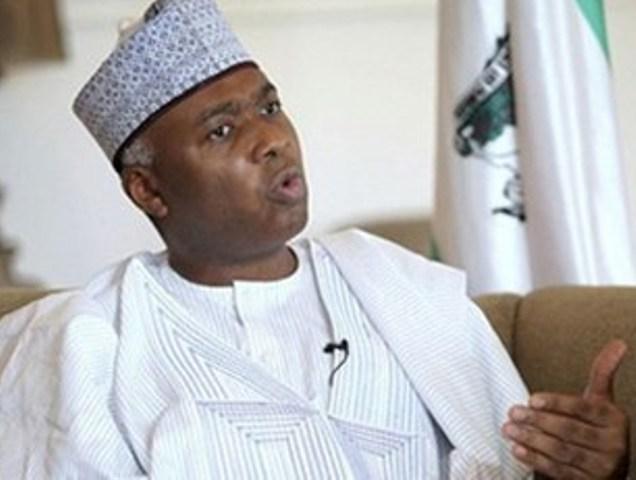
The charges were preferred against Saraki, a former governor of Kwara State, in September 2015.
The CCT, in Abuja, had, on June 14, 2017, discharged and acquitted Saraki of all the 18 charges.
The two-man panel of the CCT, led by its Chairman, Danladi Umar, unanimously upheld the no-case submission which Saraki filed after the prosecution closed its case with the fourth and the last prosecution witnesses testifying on May 4, 2017.
There were 48 documentary exhibits tendered in the course of the trial.
Umar, in his lead ruling, exonerated Saraki of all the charges on, among other grounds, that failure of the prosecution to invite Saraki for interrogation was fatal to the case.
In its notice of appeal, the Federal Government stated that the judgment "effectively" overruled previous decisions of the Court of Appeal delivered with respect to Saraki's trial and other criminal cases.
"The judgment of the lower tribunal is unwarranted, unreasonable and against the weight of evidence," the notice of appeal read in part.
The notice of appeal was signed by the lead prosecuting counsel, Mr. Rotimi Jacobs (SAN), and an Assistant Chief State Counsel in the Federal Ministry of Justice, Mr. Pius Akutah.
Describing the judgment as "unconstitutional and without jurisdiction", the appellant stated that the CCT erred in law by upholding Saraki's no-case submission "when the onus of proof" was on the Senate President to show "that there was no infraction in the Code of Conduct Forms.
It added, "By the provisions of paragraphs 11 (2), (3) and (13) of Part 1, 5th Schedule to the Constitution of the Federal Republic of Nigeria, 1999 (as amended), once the Code of Conduct form filled by the public officer is investigated and found to be false or that some assets are beyond the legitimate income of the public officer or that the assets were acquired by means of corrupt practices, the public officer concerned is deemed to have breached the Code of Conduct and it is for him to show to the tribunal that there is no infraction in the form.
"The honourable tribunal wrongly placed the onus of proof on the prosecution contrary to paragraphs 11 (2), (3) and (13) of Part 1, 5th Schedule to the Constitution of the Federal Republic of Nigeria, 1999 (as amended).
"The Constitution of the Federal Republic of Nigeria, 1999 (as amended) clearly excluded the presumption of innocence on the allegation of infraction of the Code of Conduct by public officers and the Tribunal wrongly applied the presumption of innocence contrary to the constitutional requirement.
"The tribunal's decision is unconstitutional and without jurisdiction."
But in the notice of appeal filed on Tuesday, the Federal Government sought two prayers which are "an order setting aside the ruling of the Code of Conduct Tribunal delivered on June 14, 2017 upholding the no-case submission raised by the respondent (Saraki) at the close of the prosecution's case" and "an order calling upon the respondent to enter his defence."
The Federal Government in its notice of appeal faulted all the grounds on which the CCT predicated Saraki's acquittal.
The appellant stated among others that the CCT "failed to analyse and evaluate the evidence of prosecution witnesses" before reaching the conclusion that there was no case made against Saraki.
It stated that the tribunal also failed to point out the evidence of prosecution witnesses discredited by the defence.
According to the appellant, the tribunal also failed to apply the provisions of sections 302 and 303 of the Administration of Criminal Justice Act, 2015.
The notice of appeal stated in part, "The learned members of the tribunal, in their consideration of no-case submission, failed in their duty to look at the offences charged, the ingredients of the offence and the evidence adduced by the prosecution before upholding the respondent's no-case submission.
"The learned members of the tribunal failed to analyse and evaluate the evidence of prosecution witnesses before reaching their conclusion that there is no case made out against the respondent.
"The tribunal failed in its duty to point out the material evidence adduced by the prosecution witnesses touching the ingredients of the offence charged that was discredited by the respondent's counsel during cross-examination.
"The learned members of the tribunal failed to consider and apply the decision of the Supreme Court in Daboh v State (1977) 5 SC 197 at 315, where the Supreme Court held that if the submission is based on discredited evidence, such discredited evidence must be apparent on the face of the record and that if such is not apparent, then the submission is bound to fail.
"The learned members of the tribunal failed to point out any apparent discredited evidence on the face of the record before it upheld the submission of a no case.
"The tribunal failed in its duty to point out the essential ingredients of the offences charged and the evidence adduced by the prosecution to show that the available evidence could not establish the ingredients of the offences.
"The tribunal failed to apply the provisions of sections 302 and 303 of the Administration of Criminal Justice Act, 2015 in upholding the no-case submission made by the respondent."
In the second grounds, the appellant held that in upholding the no-case submission, the tribunal ought to have only discharged Saraki, but wrongfully went ahead to discharge and acquit the Senate President.
The notice of appeal stated, "The power of the Tribunal when upholding a no-case submission is to discharge the defendant and not to acquit him.
"By section 302 of the Administration of Criminal Justice Act, 2015, the only order the Tribunal can make when a no-case submission is upheld is an order of discharge and not acquittal."
Also, the appellant faulted the claim by the CCT that the Economic and Financial Crimes Commission, which investigated the case against Saraki, failed to invite him for interrogation before charging him.
It contended that the CCT's finding was against the evidence adduced by the prosecution.
It stated that contrary to the CCT's finding, the EFCC invited Saraki and obtained his hand-written statement made by him under caution and the prosecution tendered the document before the CCT as exhibit 45.
It added that the decision by the CCT amounted to overruling its earlier ruling delivered on March 24, 2016 and the judgment of a superior court, the Court of Appeal, where "it was decided that the defendant (Saraki) needs not to be invited."
The notice read in part, "PW1 never said that the EFCC did not invite the respondent in the course of investigation of the petition against him but that PW1 did not personally invite the defendant.
"The tribunal's decision is against its earlier ruling delivered on March 24, 2016 and the decision of the Court of Appeal in Appeal No: CA/A/172C/2016 where it was decided that the defendant need not to be invited.
"The tribunal wrongly overruled the decisions of the Court of Appeal and itself."
It argued that then CCT erred when it described the testimony of a prosecution witness as hearsay.
The notice of appeal read, "PWIII is an investigator with the Code of Conduct Bureau who gave evidence of the role he played, what he saw and the outcome of his investigation.
"The Tribunal failed to consider paragraphs 11 (2), (3) and (13) of Part 1, 5th Schedule to the Constitution of the Federal Republic of Nigeria, 1999 (as amended) which imposed the onus of proof on the respondent to justify his declaration.
"The evidence of PWIII is not hearsay evidence."
In another grounds of appeal, the appellant faulted the decision of the co-member of the CCT, William Agwaza, who held that the joint investigative team, comprising operatives of the EFCC, the Department of State Services and the CCB was unknown to law.
The appellant stated, "The respondent, by his own application dated 1st March, 2016, had raised the same issue that it is only the Code of Conduct Bureau that could investigate him and that the power of investigation cannot be delegated to the EFCC or any other body or agency.
"The tribunal, by its ruling delivered on 24th March, 2016, ruled and dismissed the application of the respondent and he appealed to the Court of Appeal in Appeal No: CA/A/172C/2016.
"The Court of Appeal in the judgment delivered 27th October, 2016, by Aboki, PJCA, dismissed the appeal and held that "there is nothing in any law preventing the Code of Conduct Bureau, an agent of the Federal Government, from collaborating or acting in concert with any other organs of the Federal Government, which are also engaged in investigations and prosecution of criminal matters in order to achieve its mandate under the constitution and the law."
"By the ruling of Hon. Agwadza, he has unwittingly sat on appeal and overruled the earlier decision of the Tribunal and the decision of the Court of Appeal.
"The decision of Hon. Agwadza borders on judicial rascality and impertinence."
The notice of appeal also faulted the CCT pronouncement that the prosecution did not tender the original asset declaration forms of the respondent and his statement when they were available.
It stated, "Exhibits 1 to 6, 26 and 45 qualify as public documents under Section 102 of the Evidence Act, 2011, and there is no law that makes only the original of public documents admissible in law.
"The Tribunal failed to consider the provisions of Sections 102, 104, 105 and 146 of the Evidence Act, 2011 to the effect that a certified true copy of a public document or part thereof may be produced in proof of the contents of the public document or a part thereof.
"The Tribunal effectively overruled the decisions of the Supreme Court in Odubeko v. Fowler (1993) 7 NWLR (Pt. 308) 637 and the Court of Appeal in Tumo v. Muwana (2000) 12 NWLR (Pt. 681) 370 that courts must presume certified true copies of public document as genuine and act on it unless there is a contrary evidence.
"The Tribunal completely closed its eyes to the fact that the prosecution produced the original of the assets declaration forms before the Tribunal and requested the Tribunal and the defendant to compare the original with the certified true copies without any objection from the defendant."
The notice of appeal added, "The Code of Conduct Tribunal erred in law in upholding the no-case submission raised by the respondent at the close of prosecution's case and in discharging the respondent.
"By the authorities cited, the prosecution only has a duty to show that there are some infractions of the Code of Conduct prescribed for public officers under the Constitution and the prosecution had established those infractions through his witnesses."
Cloud Tag: What's trending
Click on a word/phrase to read more about it.
Umar Gunu National Information Technology Development Agency Adam Abdullahi Al-Ilory Bola Shagaya Yaman TVC Female National Debate Isa Aremu Kannike Tuesday Assayomo Joseph Offorjama AbdulKareem Yusuf Danhawa SWAN VADA Ilorin South Ibrahim Mohammed Presidential Election Sheikh Alimi Government House Lotus Bank Okin High School Emir Of Shonga Oluranti Idowu Ahman Pategi Kulende-UITH Usman Rifun Mahe Abdulkadir George Innih Joseph Daudu SDP Lawyers Unite Against Corruption Logun Saliu Shola Taofeek Isaac Aderemi Kolawole Ojo Fadumila Ekweremadu Haliru Dantoro Olatunji Bamgbola Salihu Ajibola Ajia Aminat Ahmed Ayobola Ipinlaiye Saidu Isa Durbar Omoniyi M. Ayinla Patience Jonathan Ayinde Oki Senate Curfew Christopher Odetunde Mike Omotosho Salihu S. Yaru Abdulkadir Orire Tunde Oyawoye Yahaya Oloriegbe Trader Moni Samuel Olusegun Adedayo Balogun-Ojomu Falokun-Oja IsDB Bola Sagaya Kayode Oyin-Zubair Okeose Christian Cementary Durosinlohun Atiku Ahman Patigi Isin Umar Bayo Abdulwahab Tsado Manman Kwara Metro Park Kassim Babamale Abdulrahman Iliasu Jimoh Saadudeen Muhammed Isiaka Rafiu Mope Hassan Taiye Salam Wahab Abayawo David Adesina The Herald Eleja Taiwo Banu Benin Republic